
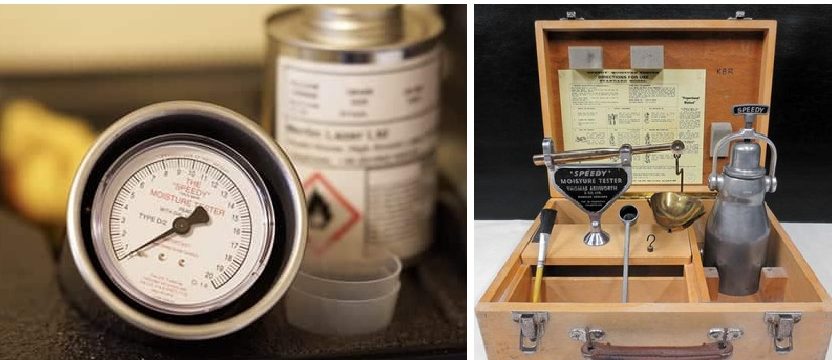
Calcium Carbide “Speedy” Meter Testing: Is It Really the Gold Standard for Damp Diagnosis?
When investigating damp in buildings, many clients request Calcium Carbide Meter testing, commonly referred to as the “Speedy” test. This method is often seen as the definitive way to determine moisture content within masonry. The Speedy Meter can offer accurate results. However, you must understand its limitations, risks, and practical drawbacks. This is especially true when compared with modern, professional use of electronic moisture meters.
What Is the Speedy Calcium Carbide Meter Test?
The Calcium Carbide test works by extracting a sample from the wall. This includes both plaster and the underlying masonry. The sample is then placed in a sealed chamber with a reagent. When moisture in the sample reacts with the calcium carbide, it produces acetylene gas. The pressure from this gas is then measured, indicating the moisture content of the sample.
While the science behind the test is sound and provides quantitative results, the process is far from simple or convenient.
The Downsides of Speedy Meter Testing
Despite its accuracy, the Speedy test has several significant drawbacks:
- Invasive Method: It requires drilling into the wall to collect samples, causing permanent damage to both plaster and substrate.
- Toxic Aftermath: The mixture inside the meter becomes hazardous after use, meaning it’s often best conducted off-site, adding to the survey time.
- Labour Intensive: Each test is time-consuming. In a standard damp survey, only around four samples can realistically be taken.
- Permission Required: Because of the destructive nature of the test, homeowner consent must be obtained beforehand. Any residual damage is not the surveyor’s responsibility.
These factors make it a more complex, costly, and time-consuming process than many clients expect.
Why Do Clients Request It?
The rise in demand for Speedy Meter testing has been largely driven by mistrust in traditional moisture meters. This mistrust is often the result of incorrect use by inexperienced or unqualified surveyors. Moisture meters have been unfairly criticised due to poor methodology, lack of context, and incorrect interpretation of readings.
However, when used by a trained and experienced damp specialist, modern electronic moisture meters can offer highly accurate, non-invasive readings. In fact, results from moisture meters often closely mirror those obtained using the Speedy test. This is especially true when the moisture meter is used correctly in combination with other diagnostic tools.
So, Which Is Better?
Both testing methods have their place:
- The Speedy Meter offers precise, numerical data—but at the cost of time, labour, and property damage.
- A professional-grade moisture meter, when used by an experienced surveyor, offers quick and reliable diagnostics. These diagnostics are non-invasive and adequate for most survey needs.
In many cases, a balanced approach is needed. Moisture meters are used as the primary tool. Speedy Meter testing is only used when absolutely necessary. This approach delivers the most efficient and responsible outcome.
Key Takeaways:
- Calcium Carbide Meter testing is accurate but invasive, toxic, and labour intensive.
- Moisture meters have been unfairly criticised due to misuse by untrained individuals.
- In skilled hands, a professional moisture meter often provides results that mirror the Speedy Meter—without damaging the property.
- Permission is always required for invasive testing, and surveyors are not liable for residual damage.
 Independent Damp Surveyors